Agustín Di Luciano
Visual artist, engineer and tech entrepreneur. He draws with graphite, with a phone, on walls, and now with bare hands in virtual space.
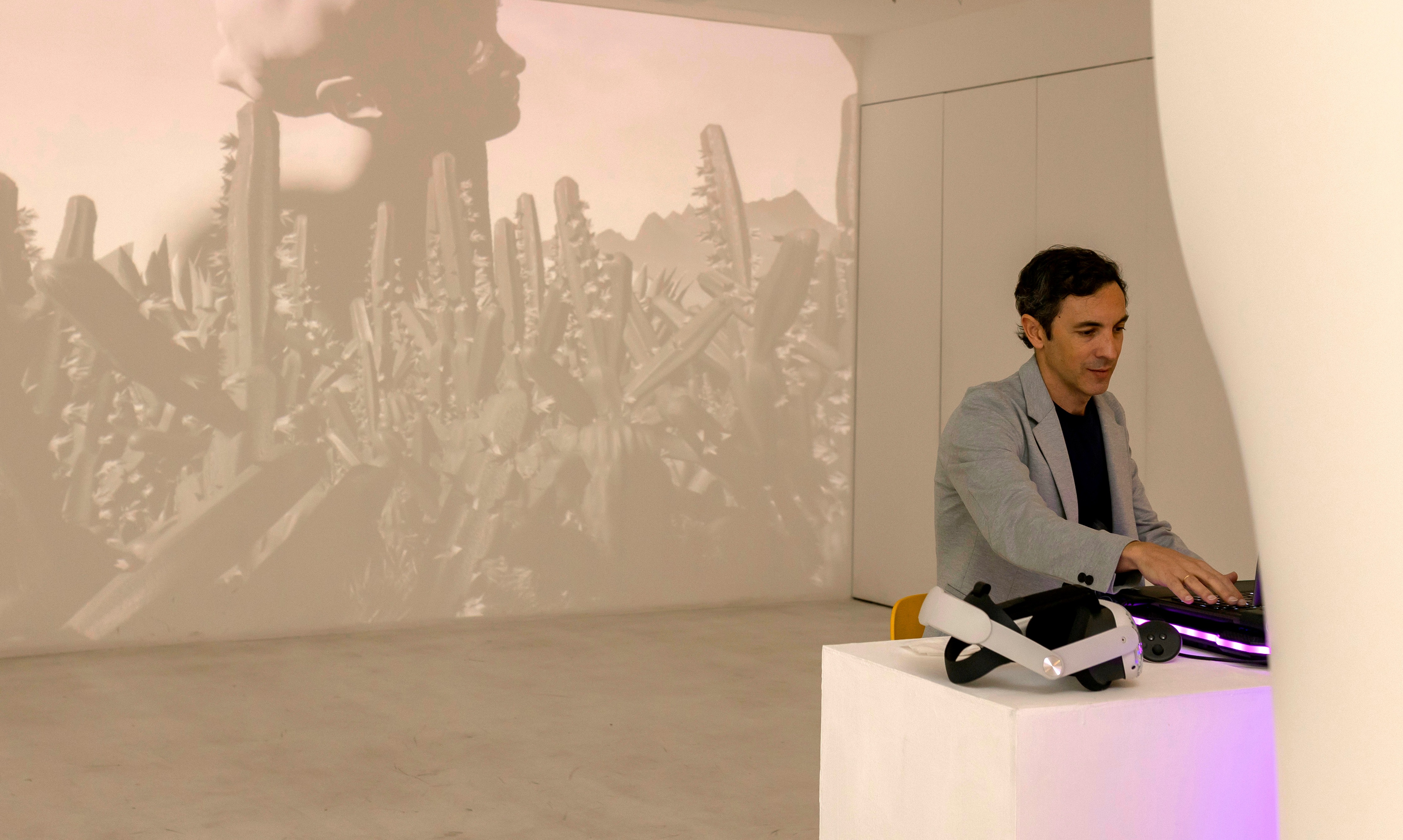
Agustín Di Luciano (b. 1981, Argentina), also known as Dilucious, is an interdisciplinary artist, engineer, and tech entrepreneur. Drawing has always been his natural introspective lens, bridging art with a lifelong passion for technology.
He graduated as an engineer from the Buenos Aires Institute of Technology (ITBA), where he received several national and international awards. A self-taught digital painter since the first iPhone, his practice ranges from mobile digital painting to large-scale public murals in Buenos Aires and Miami, and to graphite drawings on black paper that he calls the Hyperspace series.
In 2017 he became the first artist to exhibit in the open metaverse Decentraland.org, a milestone in the integration of art within immersive 3D environments. That experience, building worlds that strangers could walk through together, led directly to RealityJ.
His current practice integrates drawing and immersive 3D digital art in dialogue with artificial intelligence. RealityJ is its most complete expression: the drawings leave the page, grow into a landscape, and respond to the visitor's hands and to music.
He lives and works in Miami, where his studio, Tower Artist Studios Miami, is located in the historic Tower Hotel. He is one of its founding members.
Exhibitions and public works
A short selection. The complete CV, drawings, murals and metaverse works are on dilucious.com.
Solo exhibition Realidad Cronotópica, Museo MARCO, Buenos Aires
Founding member, Tower Artist Studios Miami
El Aleph and Other Portals, Aluna Art Foundation, Miami
NASDAQ building projection, New York
Epic Story, mural for the Buenos Aires Institute of Technology (ITBA)
First Argentine public mural in the Miami Design District
Winner, Buenos Aires Architecture Museum (MARQ), Epson LATAM
First visual artist to exhibit in Decentraland.org
Avalancha, solo exhibition, El Quetzal Gallery, Buenos Aires
iPad art at SXSW Festival, Austin, Texas
Over 1,000 people have tried RealityJ in person
RealityJ was built in front of its audience. Between the museum run in Buenos Aires and the studio and open-air sessions in Miami, with detours as far as a San Francisco rooftop, more than a thousand visitors have put on the headset with the artist beside them, from children to grandparents, from first-time VR users to curators. Their reactions, confusions and laughter shaped every version of the work.
Realidad Cronotópica
Museo de Arte Contemporáneo de La Boca (MARCO), Buenos Aires, 2025. Curated by Melina Ojagnan.
Agustín Di Luciano designs an experience where art and technology amplify each other to transform drawing into a living, boundless landscape, creating a universe where the senses intertwine within a state-of-the-art immersion.
The exhibition unfolds within an expanded notion of time and space. The concept of the chronotope, taken from philosopher and theorist Mikhail Bakhtin, refers to the way time and space intertwine within an artistic form. Di Luciano translates this idea into a contemporary language by merging drawing, virtual reality, and artificial intelligence to inhabit a digital chronotope: an environment where plastic matter becomes responsive to the viewer's movement, gaze, and awareness.
In a hypnotic visual terrain emerging from the depth of black, the artist shapes a hybrid, sensitive landscape: skies inhabited by his moving drawings, luminous portals, and a desert of cactaceous plants arising from a reactive ground. This universe forms a constellation of experiences that unfold uniquely with each journey, directed, activated, and transformed by the audience itself.
Di Luciano invites us to remember that, at the intersection of time, technology, and landscape, a possibility of re-enchantment still beats within us: to once again perceive the world as something alive, mysterious, and deeply connected.
— Melina Ojagnan, curator
Foundational story
Since 2017, I have been an early contributor to Decentraland.org, proposing a user-owned, blockchain-based metaverse. That experience showed me how the metaverse can become a space to build better worlds, ones that can positively influence our physical reality.
Most VR apps today focus on competition, combat, or productivity, while the art world remains mostly static and 2D. With today's immersive tools, we can go beyond that: we can create art that heals and helps people feel better.
This mission became personal when someone I love fell into depression. As she recovered, she tried my VR work and said, “Wow, this feels like a dream.” That moment confirmed my belief that art and technology together can lift emotional states and help people reconnect with joy.
— Agustín Di Luciano