A reading of RealityJ as a work of contemporary art: what it is, the lineage it belongs to, the sources it draws on, and the questions visitors ask most.
I
What the work is
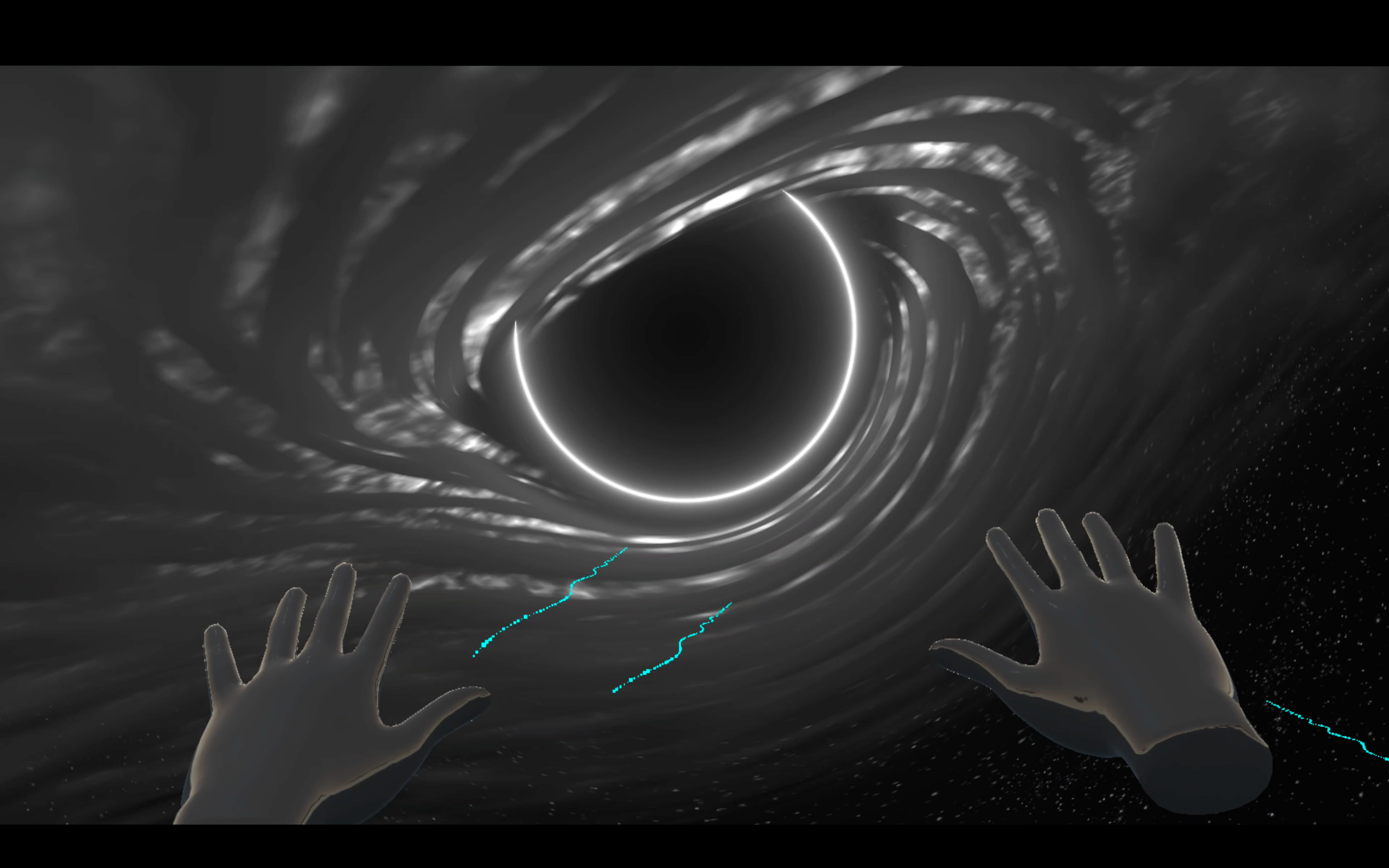
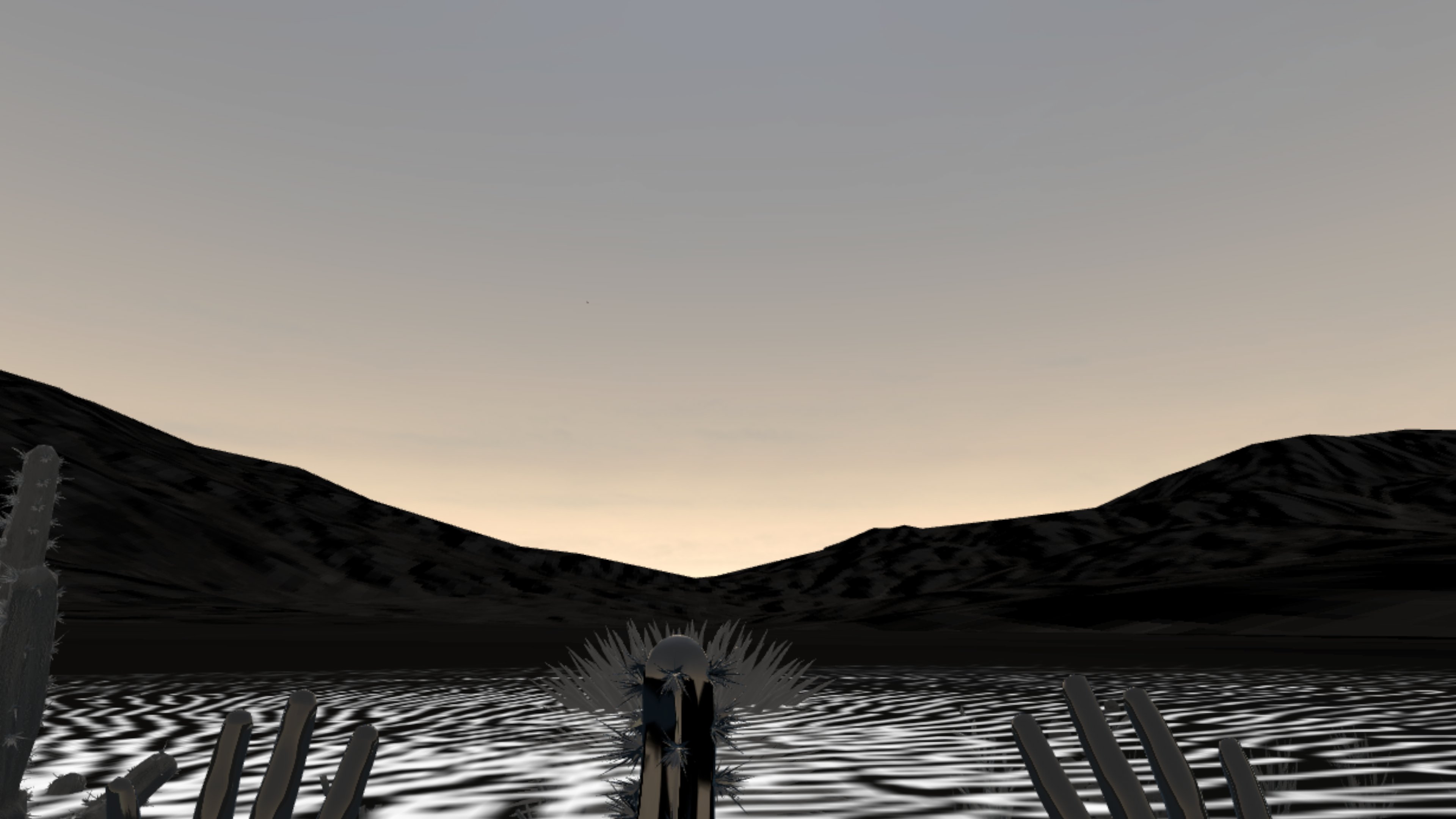
RealityJ is a hand-made virtual world that a visitor enters alone, with bare hands, for a few minutes at a time. It begins in darkness. White lines, the same lines the artist draws in graphite on black paper, hang in the air as orbits, portals and sentient forms. A desert of cacti rises from the ground where you stand. Music plays, and the world listens to it: growth, light and motion follow the beat and the timbre. Your hands draw in space, open portals and touch what blooms. Nothing you do is scored, and nothing can be done wrong.
The work's medium is not, strictly, the headset. It is the relation between a drawing, a piece of music and a body. Each of these is time-based, and RealityJ fuses them into a single duration that the exhibition title names with Bakhtin's word: a chronotope, a time-space. The artist has described drawing as his introspective lens; here the lens is turned inside out, and the viewer stands inside the drawing's own time.
It is not just seeing art, it was being part of it.
Three decisions define the work's position. First, it is drawn, not generated: the AI analyses sound but never invents an image. Second, it is controller-free, so the gesture of drawing survives the move into three dimensions. Third, it is distributed free on a consumer headset, which removes the laboratory, the gallery and the ticket between the artwork and the person. Together these make RealityJ an unusually direct answer to a question that has been asked since the first panorama: what happens when the picture surrounds you and responds?
II · Historical framework
A lineage of immersion
Virtual reality did not arrive in art from outside. It is the latest form of five long tendencies, and RealityJ inherits each of them, with a distinctly Argentine thread.
Antiquity to 1800
The immersive image before the screen
Long before headsets, artists tried to surround the viewer. The frescoes of the Villa of the Mysteries in Pompeii wrap a room in a continuous scene; Baroque ceilings open fake skies above the faithful; Robert Barker patented the panorama in 1787, a circular painting you stood inside. Media historian Oliver Grau traced this line in Virtual Art: From Illusion to Immersion (2003) and showed that the desire to step into the picture is as old as painting itself. RealityJ belongs to that desire, with the difference that the picture now answers back.
1946 to 1970
The spatial turn, seen from Buenos Aires
In 1946 Lucio Fontana, born in Rosario, Argentina, signed the Manifiesto Blanco in Buenos Aires and launched Spatialism: art should abandon the flat surface and work with space, light, time and movement. That same year the Madí group formed in the city, and Gyula Kosice began his hydrokinetic sculptures and the Hydrospatial City, a habitable art-world suspended in the air. Julio Le Parc, another Argentine, co-founded GRAV in Paris in 1960 to make light and movement the material of art and the spectator an active participant. RealityJ is a direct descendant of this Argentine avant-garde: drawing that leaves the page to become a space you can enter, light that moves, and a viewer who is no longer a viewer.
1960s to 1990s
The participatory turn
Fluxus scores and happenings made the audience's action part of the work. In 1974 Myron Krueger began Videoplace, an 'artificial reality' in which a camera read the body and the image reacted, the ancestor of today's hand tracking. California's Light and Space artists, James Turrell and Robert Irwin among them, made perception itself the subject. In 1998 Nicolas Bourriaud named 'relational aesthetics' for art whose substance is the encounter it produces. RealityJ is relational in the plainest sense: it does not exist until someone moves inside it.
1965 to 1995
The first virtual reality art
Ivan Sutherland described 'the ultimate display' in 1965 and built the first head-mounted system in 1968. Jaron Lanier's VPL Research popularised the term 'virtual reality' in the late 1980s. Artists followed at once. Jeffrey Shaw's The Legible City (1989) let you cycle through a city made of words; Char Davies's Osmose (1995) used breath and balance to float through a forest of light, and remains the clearest precedent for RealityJ's meditative, bodily navigation. Those works needed a laboratory and a technician. RealityJ runs on a headset you can buy in a shop, which changes who gets to have the experience.
2015 to today
Institutional consolidation
When consumer headsets returned in the 2010s, VR entered the art world's main institutions. Rachel Rossin showed painted VR worlds in New York in 2015; Google's Tilt Brush (2016) made drawing in the air a mass practice; Laurie Anderson and Hsin-Chien Huang won the first Best VR Experience award at the Venice Film Festival in 2017; Jordan Wolfson's Real Violence was the most discussed work of the 2017 Whitney Biennial; Marina Abramović and Anish Kapoor made VR pieces with Acute Art in 2018. Museums learned to show headsets. Realidad Cronotópica at Museo MARCO in 2025 placed RealityJ in this institutional history from Latin America.
III · Inspiration
Sources
The images, ideas and places the worlds are built from.
Drawing, and the Hyperspace series
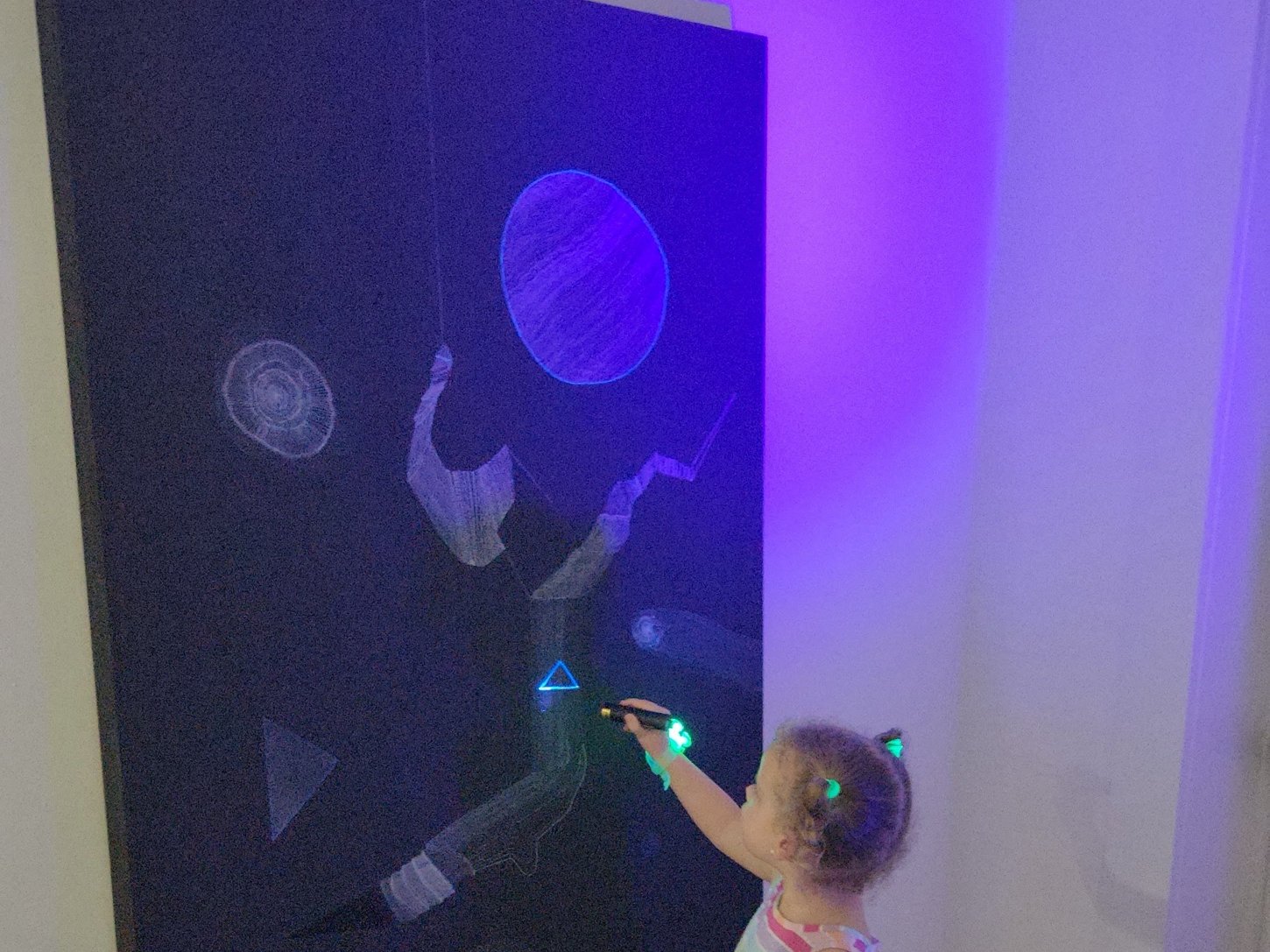
Every form in RealityJ begins as a line drawn by hand: graphite on black paper, or a finger on a phone screen. The white-on-black drawings of the Hyperspace series, with their orbits, portals and sentient forms, are the vocabulary the worlds are built from.
Bakhtin's chronotope
The literary theorist Mikhail Bakhtin coined 'chronotope', literally time-space, for the way a narrative fuses the two into one perceivable thing. The exhibition title Realidad Cronotópica names the ambition: a drawing you inhabit is a drawing with duration.
Borges and the Aleph
In Borges's 1945 story, the Aleph is a point that contains every other point in the universe, seen at once. RealityJ's portals are Alephs you can step through, and the 2025 Miami exhibition El Aleph and Other Portals made the link explicit.
The Argentine landscape
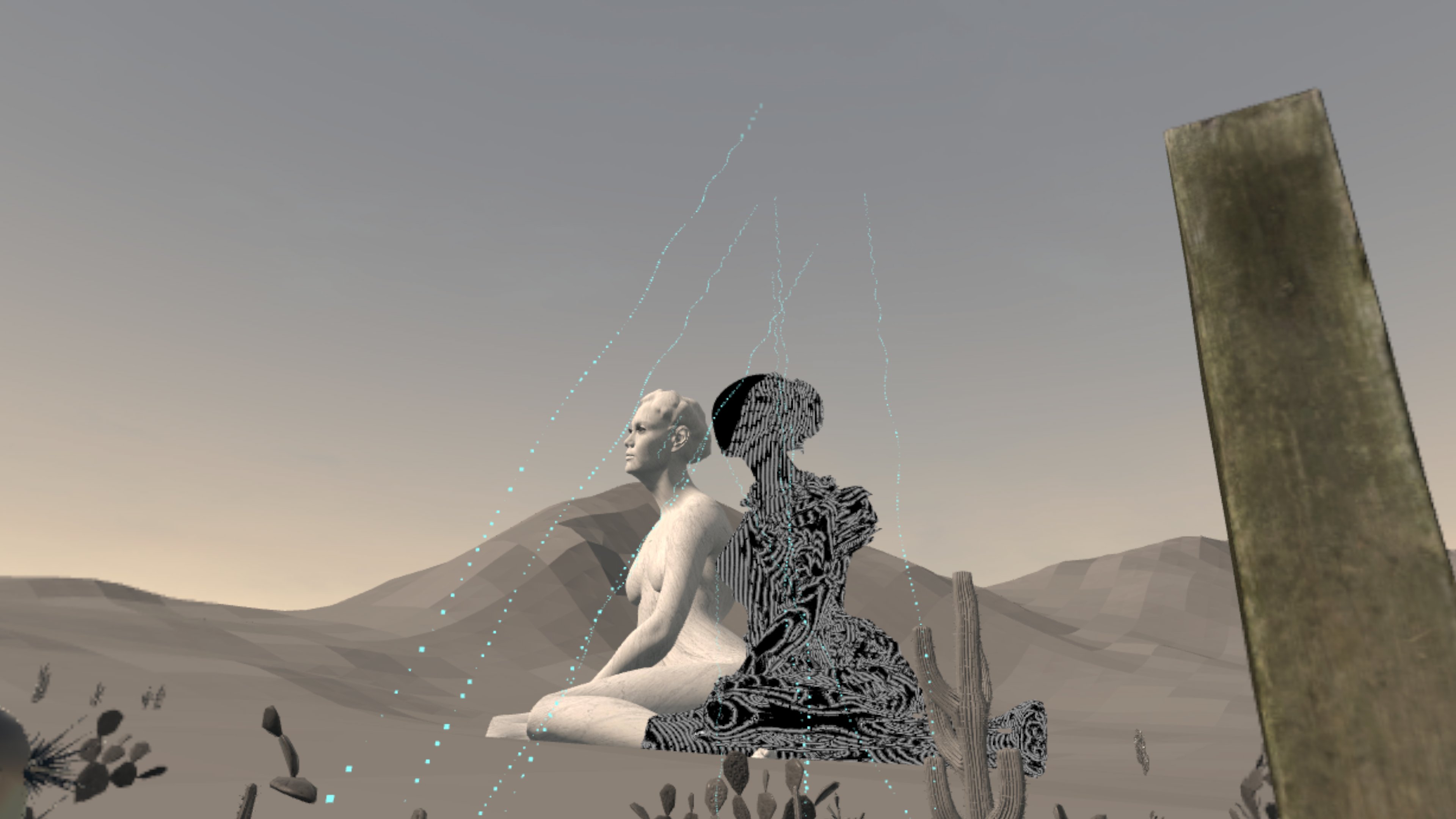
The desert of cacti that grows from the reactive ground recalls the cardones of the Argentine Northwest; the Forest Goddess world grows out of forests the artist has drawn, painted and defended since Forests Win (2017) and the Bring Nature to BA mural grant (2015).
Fontana, Kosice, Le Parc, Xul Solar
The Argentine tradition of making art a space rather than an object, and of inventing private cosmologies, as Xul Solar did with his painted worlds and invented languages, gives RealityJ its local lineage.
Music and synaesthesia
Kandinsky wrote in 1911 of colour as a keyboard and the soul as a piano; Oskar Fischinger animated abstract forms to music in the 1930s. RealityJ's AI music analysis lets sound shape growth and light, so the world becomes a visual instrument you play by moving.
The open metaverse
Building in Decentraland from 2017 taught the artist that a virtual space can be a commons. RealityJ is distributed free for the same reason: an artwork that anyone can keep.
Art that helps people feel better
The project's origin is personal, told on the About page. RealityJ is made in the belief that immersive art can lift an emotional state, and it was tested on more than a thousand people in Miami and Buenos Aires to find out whether that was true.
Hyperspace drawing, on paper
Desert Meditation
Forest Goddess
IV · FAQ
Questions visitors ask
Is RealityJ a game, an app, or an artwork?+
It is an artwork that uses the distribution channel of an app. There is no score, no goal and no way to win. You move, draw and touch, and the world responds. Think of it the way you would think of a Turrell room or an Eliasson installation: a place you spend time in, rather than a task you complete.
Who made it, and what did they make by hand?+
Agustín Di Luciano drew, modelled, animated and programmed the worlds himself, over roughly two years, with the music analysis and interaction systems written in Unreal Engine. The drawings come from his graphite and iPhone practice; the hand-tracking and reactive systems are his engineering. It is a single-author work in the way a painting is, even though it runs on a computer.
Is every visit the same?+
No. The worlds are procedural and reactive, so what grows, blooms or opens depends on where you are, what you do with your hands and what the music is doing at that moment. Two visitors never see the same work, and you never see the same work twice. This is why the exhibition text describes it as unrepeatable.
Why no controllers?+
Because drawing has always been done with the hand. Controllers put a tool between you and the line; hand tracking lets the gesture itself be the mark. It also lowers the threshold: visitors who have never used VR, including children and older people, understand what to do within seconds.
How does it relate to the artist's drawings on paper?+
Directly. The Hyperspace drawings are white line on black ground; RealityJ begins in the same darkness and the same lines, now three-dimensional and in motion. The museum exhibition in Buenos Aires showed both side by side, and the Miami exhibition El Aleph and Other Portals hung the drawings alone. The VR is not an illustration of the drawings; it is the drawings continued in time.
How is it exhibited in a museum?+
One visitor at a time wears a Meta Quest headset inside a dedicated space (at Museo MARCO, a white sculptural pavilion). A monitor mirrors what the visitor sees, so the people waiting share the experience as spectators, and the artist or a mediator is present to help. Sessions last a few minutes. Over the run of the show and the Miami studio sessions, more than a thousand people have taken part.
Can I own it or collect it?+
Anyone with a Meta Quest 3, 3S or Pro can download it free and keep it. For collectors and institutions, the artist produces exhibition editions and site-specific installations (pavilion, projection, drawings) and can be reached through the contact page.
Is it safe and comfortable?+
The work is designed for stillness: you stand or sit, and the world comes to you, so motion sickness is rare. Hand tracking means nothing to hold. The experience has no violence, no jump scares and no competition. Children have used it under supervision at the museum.
What does the AI actually do?+
It listens. The music is analysed for beats, loudness and timbre, and those numbers drive growth, light and motion in the world. The AI does not generate the images; every image was drawn by the artist. It is closer to a conductor than to a painter.
Where can I read more or see the drawings?+
The artist's full portfolio, exhibitions and curatorial texts are on dilucious.com. The technology, and the case for VR in contemporary art, is explained on the Technology page.